


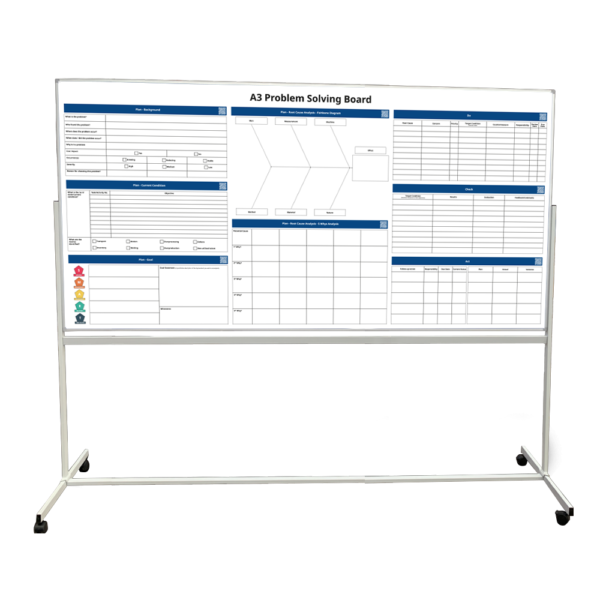
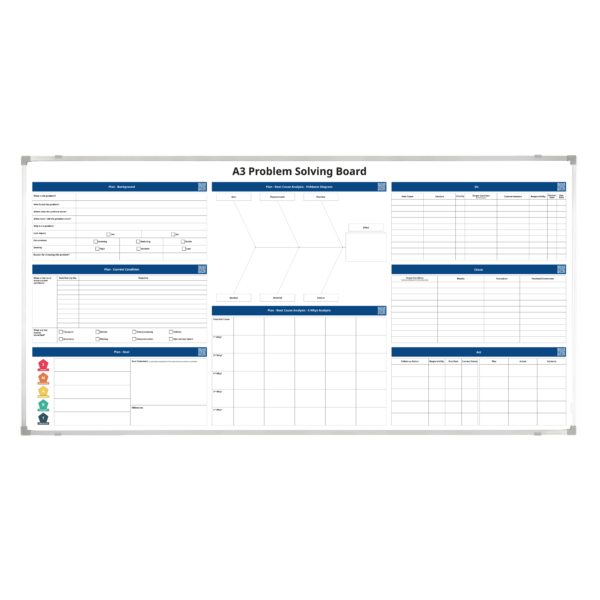
A mobile A3 Problem solving board printed on the one side with 8 modules covering Plan: Background, Current condition, Goal, Root cause analysis, 5 Whys & Do, Check, Act. The reverse is a plain magnetic whiteboard. The sturdy stand has a fixed whiteboard and comes with 4 wheels, two of which are lockable.
A3 Problem Solving is an effective and structured problem-solving method coined by Toyota. Their aim was to bring down the problem-solving report-writing down to one page. The name is taken from the international standard name for the A3 paper size 297×420 mm. The A3 report structures are predominantly based on the Plan-Do-Check-Act (PDCA) cycle.
Plan – Background
Within the planning stage, the background contains a description of all pertinent information needed to understand the scope of the problem at hand, its cost impact, occurrence, pattern, and severity. It sets the scene for the problem solving and root cause analysis and determines the context required for comprehensive understanding of the problem. It also gives you an opportunity to ascertain the importance of the problem by stating valid reasons for choosing this for the problem-solving exercise.
Plan – Current Condition
This section captures the current state of the condition.
Plan – Goal
The SMART acronym outlines a strategy for achieving a goal. SMART goals are Specific, Measurable, Achievable, Realistic and anchored within a Time Frame. This helps in setting a clear roadmap of how you will reach your intended goal.
Plan – Root Cause Analysis / Fishbone
The Fishbone diagram (also called the Ishikawa diagram) is a tool for identifying the root causes of problems. It may also be referred to as a cause-and-effect diagram. It is an analysis tool that provides a systematic way of looking at effects and the causes that create or contribute to those effects. It is a graphic representation that schematically illustrates the relations between a specific effect and its causes.
Plan – 5 Whys Analysis
By repeatedly asking the question “Why” (five is a good rule of thumb), you can peel away the layers of symptoms which can lead to the root cause of a problem. This tool is also used to determine the relationship between different root causes of a problem.
Do
This step is where the actual implementation of problem solving takes place. It is a visual problem-solving tracker that provides a structured approach to resolving issues with the help of countermeasures
Check
This step is basically an evaluation of the actual implementation results based on the target condition.
Act
This is the final step and helps you look at what you’ve achieved against what you initially set out to achieve. It helps you assess your performance and highlights the difference between the plan and the actual.
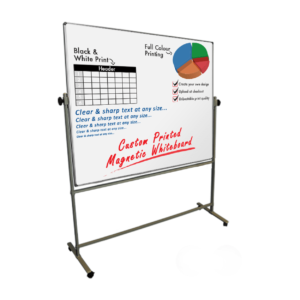
We can also custom print your own A3 problem solving design onto a whiteboard for you.




&url=https://magiboardsusa.com/product/magnetic-dry-erase-labels/&media=https://magiboardsusa.com/wp-content/uploads/2022/04/A046LAB011-1024x1024.png)
